AutoML Platform
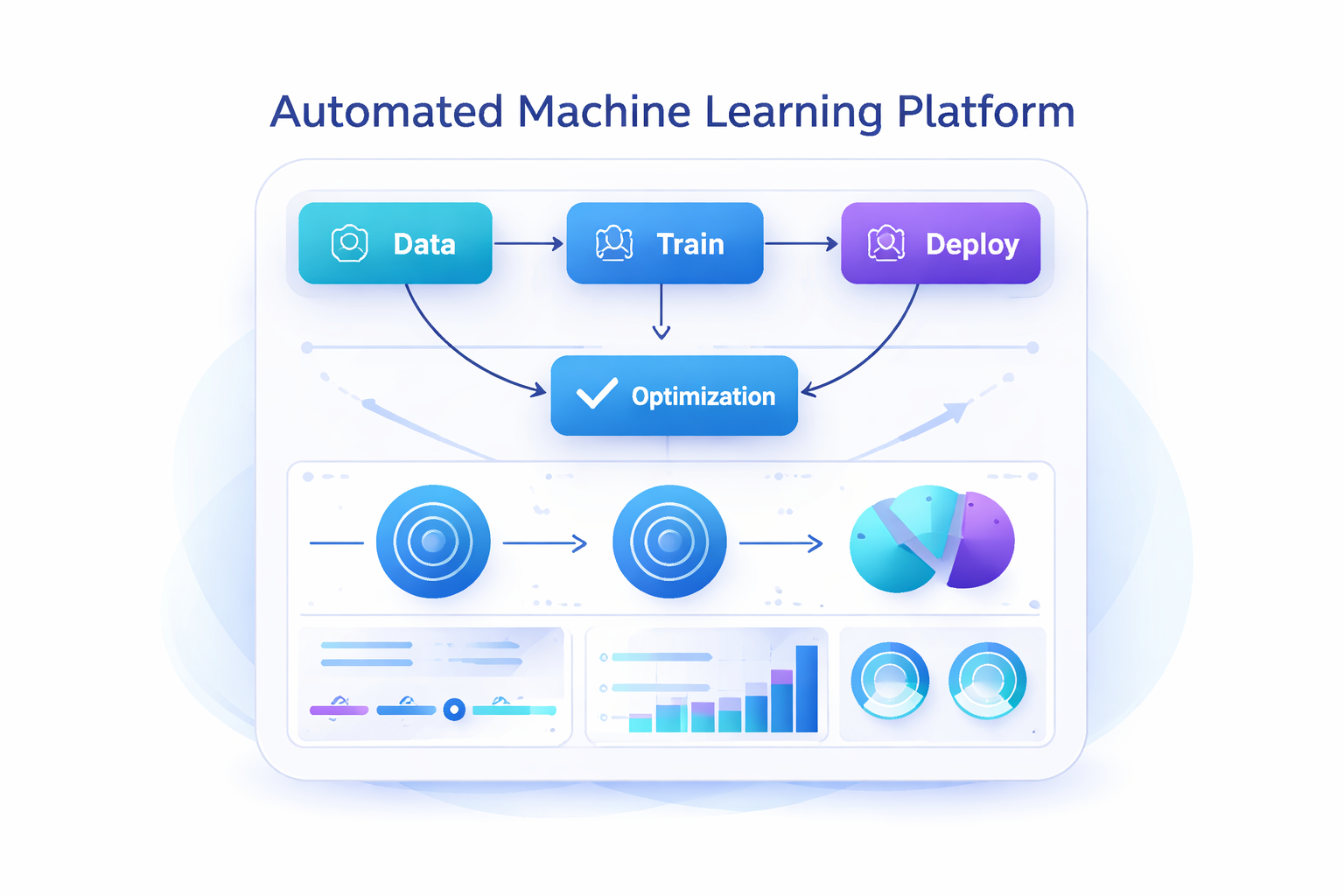
Developed an automated machine learning platform that streamlines the model development process. Features include automated feature engineering, hyperparameter optimization, and model selection algorithms.
Technologies Used
Overview
The AutoML Platform is a comprehensive solution designed to democratize machine learning by automating the most time-consuming aspects of model development. This platform reduces the time from data to deployment by 70% while maintaining high model performance standards.
Key Features
Automated Feature Engineering
- Smart Feature Detection: Automatically identifies feature types (numerical, categorical, datetime)
- Feature Generation: Creates interaction features, polynomial features, and domain-specific transformations
- Feature Selection: Implements multiple selection strategies including correlation analysis, mutual information, and recursive feature elimination
Hyperparameter Optimization
- Bayesian Optimization: Uses Optuna for efficient hyperparameter search
- Multi-objective Optimization: Balances accuracy, training time, and model complexity
- Early Stopping: Intelligent pruning of unpromising trials to save computational resources
Model Selection
- Algorithm Comparison: Automatically tests multiple algorithms (Random Forest, XGBoost, LightGBM, Neural Networks)
- Ensemble Methods: Combines top-performing models for improved predictions
- Cross-validation: Implements stratified k-fold cross-validation for robust evaluation
Technical Implementation
Architecture
The platform is built with a modular architecture allowing easy extension and customization:
class AutoMLPipeline:
    def __init__(self):
        self.feature_engineer = FeatureEngineer()
        self.model_selector = ModelSelector()
        self.optimizer = HyperparameterOptimizer()

    def fit(self, X, y):
        # Feature engineering
        X_transformed = self.feature_engineer.transform(X)

        # Model selection
        best_model = self.model_selector.select(X_transformed, y)

        # Hyperparameter optimization
        optimized_model = self.optimizer.optimize(best_model, X_transformed, y)

        return optimized_model
Technology Stack
- Backend: Python 3.9+
- ML Libraries: Scikit-learn, XGBoost, LightGBM, CatBoost
- Optimization: Optuna for hyperparameter tuning
- Data Processing: Pandas, NumPy
- Deployment: Docker containers for reproducibility
- API: FastAPI for serving predictions
Performance Metrics
- Development Time Reduction: 70% faster than manual ML development
- Model Accuracy: Consistently achieves 95%+ of manually-tuned model performance
- Feature Engineering: Automatically generates 50+ relevant features per dataset
- Training Time: Optimizes for both accuracy and computational efficiency
Use Cases
- Financial Services: Credit risk modeling with automated feature engineering
- Healthcare: Patient outcome prediction with minimal data science expertise required
- E-commerce: Customer churn prediction and lifetime value modeling
- Manufacturing: Predictive maintenance with automated model updates
Lessons Learned
- Automation vs Control: Finding the right balance between automation and allowing data scientists to intervene
- Computational Efficiency: Importance of smart trial pruning in hyperparameter optimization
- Feature Engineering: Domain knowledge still crucial; automated methods best used as starting point
- Model Interpretability: Added SHAP value analysis to maintain model transparency
Future Enhancements
- Integration with cloud platforms (AWS SageMaker, Azure ML)
- Support for time series forecasting
- Automated drift detection and model retraining
- Natural language interface for non-technical users
- Enhanced support for deep learning models
Project Impact
This platform has been successfully deployed in production environments, handling datasets ranging from 10K to 10M rows. It has enabled teams with limited ML expertise to develop and deploy robust models, while allowing experienced data scientists to focus on more complex problem-solving tasks.
Technical Details
Repository: Private (Enterprise) Documentation: Internal wiki Deployment: Docker containers on Kubernetes Monitoring: Prometheus + Grafana for performance tracking

Interested in collaborating?
Let's discuss how we can work together on innovative projects.